By 'Physical Number Theory', I am referring to ways of visualising number theory, by imagining physical objects. This is interesting to me because I think best by visualisation, and I enjoy finding ways to make the abstract concrete. Although visualisation is no substitute for formal proof, and intuition can be misleading, visual interpretations can usually help us develop greater insight than blind symbol-pushing.
Fermat's Little Theorem With Bracelets
My favourite proof of Fermat's Little Theorem is one of these cases where quite an abstract concept becomes almost self-evident when viewed from a certain perspective.
Because the proof is so intuitive, I don't think you even need to know the theorem to follow it. The proof goes like this:
- Imagine that you have an unlimited supply of beads, coming in \(a\) different colours . You want to design bracelets with \(p\) beads each (where \(p\) is a prime).
- Now ask, how many different bead-strings can you make? The answer is \(a^p\), because there are \(a\) options for the colour of each of the \(p\) beads, and the order matters. But, if the ends are joined up (seamlessly) to make bracelets then many of these will end up looking the same.
- Clearly, there are just \(a\) bead-strings that use only one colour, because there are \(a\) colours available.
- For a bracelet design using more than one colour, there are exactly \(p\) different bead-strings that can produce it, because the first bead could be taken to be any of the \(p\) beads, and because \(p\) is prime, there can't be any repeated patterns in the bracelet so these \(p\) bead-strings are all genuinely different.
- Therefore, the number of bead-strings using more than one colour is \(a^p-a\), and this is a multiple of \(p\).
- So, \(p\) divides \(a^p-a\), so \(a^p =a\;\text{mod}\;p\). This proves the theorem. :)
Proof Without Words: Nicomachus' Theorem
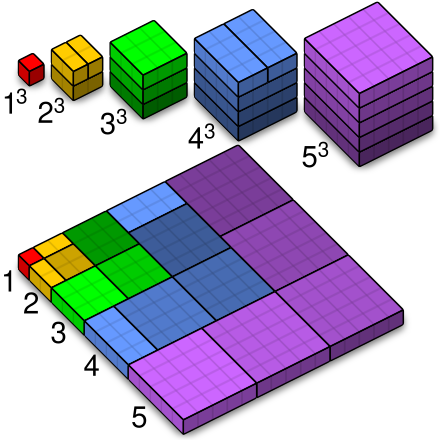
\[ \text{e.g.:}\;\;2025 = 1^3+2^3+ ... + 9^3 = (1+2+...+9)^2 \]
Cicadas
A blog post about physical manifestations of number theory would not be complete without mentioning the lifecycles of competing species of Cicadas in North America. Long story short, Cicadas lie dormant most of the time and only come out to reproduce. According to University of Connecticut, there are seven species — four with 13-year life cycles and three with 17-year cycles. The theory is that nature chose these lifecycles because on average, prime number lifecycles are least likely to line up with the lifecycles of other animals (and lifecycles lining up might mean too much competition for resources).
2024 was a special year for the periodic cicadas, because two species (a 13-year and a 17-year variety) emerged simultaneously, for the first time since 1803. Read more here.